How to Choose the Best Large Magnetic Building Blocks for Toddlers
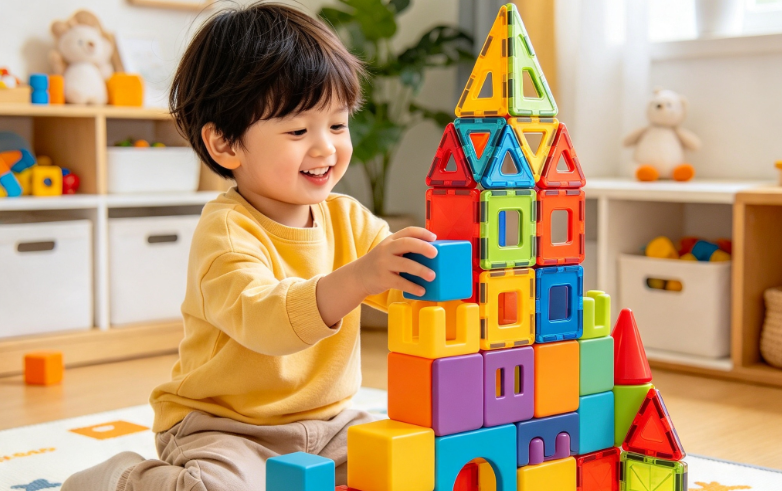
Your 22-month-old holds two tiles close together. Click. They snap. She pulls them apart, then does it again. And again. Twenty minutes pass, and she hasn't looked at a screen once.
That click is the hook. Magnetic tiles connect with almost no effort, so toddlers get a result every time. No pressing. No lining up studs. No frustration.
Magnets also bring a safety question that foam and wooden blocks don't. Pick the wrong set, and a cracked tile can expose a small, powerful magnet. This guide covers how to choose the best large magnetic building blocks for toddlers, how to introduce them, and how to keep them safe and useful for years.
You'll learn:
- Which safety standards to check in the US and EU
- Why panel size matters more than piece count
- How tile-style and bar-style magnets work, and which suits toddlers
- What toddlers learn from 18 months to 3 years
- A week-one plan, storage tips, and ways to extend play
---
Why Magnets Change the Rules
Foam blocks are soft. Wooden blocks are solid. Magnetic blocks have something hidden inside: small magnets sealed in plastic housing.
That design is safe when the housing stays intact. The risk starts when it doesn't.
If a child swallows two or more loose magnets, they can attract each other through the walls of the intestines. This causes serious internal injury. One magnet can also attract to a swallowed metal object. It's the main reason magnetic toys follow stricter rules than ordinary blocks.
The good news: well-made large magnetic building blocks are designed so magnets never come loose, even after drops, bites, and stomping. Your job is to know what "well-made" looks like.
| Block Type | Main Safety Concern | What Protects Your Child |
|---|---|---|
| Foam blocks | Bitten-off pieces | Dense foam, weekly checks |
| Wooden blocks | Splinters, paint | Smooth finish, non-toxic paint |
| Magnetic tiles | Loose magnets after cracks | Certified housing, sealed seams, large panels |
---
Step 1: Check the Magnet Safety Standards
This step takes two minutes. Do it before anything else. Look on the box, the product page, or ask the seller for test reports.
United States
| Standard | What It Means for Magnetic Toys |
|---|---|
| ASTM F963 | The core US toy safety standard. Includes specific magnet rules. Any loose magnet small enough to swallow must be weak enough to pass a "flux index" limit. Toys also go through abuse tests (drops, twisting, pulling, soaking) to check magnets stay sealed inside. |
| CPSIA | Federal limits on lead and certain phthalates in children's products. |
| Small parts rule | Toys for children under 3 can't have any piece that fits inside a test cylinder about 1.25 in (3.17 cm) wide. This applies before and after abuse testing. |
| Children's Product Certificate (CPC) | The seller's written proof of third-party lab testing. Reputable shops provide it on request. |
European Union and UK
| Standard | What It Means for Magnetic Toys |
|---|---|
| CE mark | The manufacturer declares the toy meets EU toy safety rules. |
| EN 71-1 | Mechanical and physical safety. Covers magnet strength limits, small parts for under-36-month toys, and a soaking test that checks if magnets loosen after time in liquid. |
| EN 71-3 | Limits on heavy metals that can migrate from toy materials. |
| EN 62115 | The safety standard for electric toys. It includes its own magnet requirements. Check for it if a magnetic set has lights, sounds, or batteries. |
| UKCA or CE mark | Either mark appears on toys sold in Great Britain. |
The One Label That Ends the Search
If the box says "Not suitable for children under 36 months" or "Ages 3+," it's not a toddler toy. Many magnetic tile sets carry a 3+ rating because they include small pieces, like wheels, figures, or mini connectors. Skip those until your child turns 3.
PRO TIP: Search the product page for "18M+" or "18 months+." Sets tested for younger children say so clearly. No age statement? Ask the seller before you buy.
---
Step 2: Why Panel Size Matters for Toddlers
Piece count gets the headlines. For toddlers, size matters more.
Bigger Panels Mean Bigger Housing
A large tile holds its magnets deeper inside thicker plastic. More plastic around each magnet means more protection from cracks. It also means that even a broken edge rarely exposes anything small enough to swallow.
Size Guide by Age
| Age | Smallest Piece to Look For | Why |
|---|---|---|
| 18–24 months | 3 in (about 7.5 cm) squares and larger | Two-hand grip. Far too big for a mouth. |
| 2–3 years | 3 in squares, plus large triangles and rectangles | One-hand building with no small parts. |
| 3 years+ | Mixed sizes, including smaller add-ons | Ready for more detail, under supervision |
Many toddler sets go bigger: 4 to 6 in (10 to 15 cm) "jumbo" tiles. These make tall walls fast. Toddlers love building something taller than themselves.
Thickness Counts Too
Look at the tile edge in product photos. A thin, flimsy edge cracks more easily under a stomp. Thick, rounded edges hold up better and feel safer in small hands.
The Toilet Paper Tube Double-Check
A toilet paper tube is about 1.75 in wide. That's wider than the official small parts cylinder. If any piece slides through, keep it away from your toddler. It's not a lab test. It's a fast, cautious check you can do at home.
🧱 Compare tile sizes and age ratings side by side. Browse toddler-friendly sets at BrickHobby.
---
Step 3: Understand Tile-Style vs. Bar-Style Magnets
Not all magnetic blocks connect the same way. Two main designs show up in stores. Knowing how they work helps you pick the right one.
Tile-Style Sets
Flat plastic panels (squares, triangles, rectangles) with magnets sealed along each edge. Most toddler tiles use small cylinder-shaped magnets that spin freely inside their pockets. When two tiles meet, the magnets rotate to match polarity. Any edge sticks to any edge.
That's why toddlers succeed right away. No wrong side. No push-back.
Bar-Style Sets
Rods or sticks with magnets at each end. They connect to each other or to steel balls to form frames and 3D shapes. Polarity often matters. Two ends can push apart instead of sticking.
Many bar-style sets use small steel balls. Those fail the small parts rule for children under 3.
Side-by-Side Comparison
| Feature | Tile-Style | Bar-Style |
|---|---|---|
| How magnets work | Rotating magnets, any edge connects | Fixed ends, polarity often matters |
| Ease for toddlers | High. Instant success | Lower. Pieces can repel |
| Small parts risk | Low with large tiles | High if steel balls are included |
| What kids build | Walls, floors, cubes, towers | Frames, skeletons, geometric shapes |
| Best age | 18 months+ (large, certified sets) | Usually 3+ or older |
| Translucent options | Common. Great for light play | Rare |
Our Pick for Toddlers
Large tile-style sets win for children under 3. They're simpler, sturdier, and designed with fewer small pieces. If you like bar-style, choose a set made for under-3s with chunky rods and no loose balls. Save the rest for preschool.
PRO TIP: Hold two tiles a finger's width apart. They should pull toward each other gently. A toddler should be able to separate them with two hands. Too strong, and kids give up. Too weak, and towers collapse.
---
Step 4: What Toddlers Learn by Age
Magnetic tiles grow with your child. The same set offers new challenges every few months. Use this table as a guide. Every toddler moves at their own pace.
| Age | What You'll See | Skills Building |
|---|---|---|
| 18–24 months | Snapping two tiles, pulling apart, laying tiles flat on the floor, banging tiles together | Grip, cause and effect, hand strength, early color names |
| 24–30 months | Flat "floors" and "rugs," short walls, stacking tiles into a solid pile | Hand-eye coordination, shape recognition, sorting |
| 30–36 months | Folding flat shapes into cubes, simple houses, garages for toy cars, towers | Spatial thinking, planning, early math words (tall, short, more), pretend play |
The Flat-to-3D Moment
Watch for this one. Around 2.5 to 3 years, many children lay out a cross of six squares and fold it up into a cube. It happens suddenly. That's real spatial reasoning. It's the same skill behind reading maps, solving puzzles, and later, geometry.
STEM Starts Here
You don't need lesson plans. Magnetic tiles teach balance (wide bases stand, narrow ones fall), symmetry, and early engineering. Toddlers learn by testing. You just name what happens: "The tower fell. It was very tall!"
Screen-Free Focus
Many parents notice tiles hold attention longer than other toys. The instant click gives quick rewards without a screen. A 25-minute session at age 2.5 is common.
---
Step 5: The Week-One Introduction Plan
Start small. A few tiles and a simple setup make the first week calm and fun. You'll also see how your toddler handles them.
| Day | Activity | Tiles to Use | What to Watch |
|---|---|---|---|
| Day 1 | Snap and pull. Sit together and click tiles. | 4–6 squares | Grip strength. Any biting? |
| Day 2 | Floor puzzle. Lay tiles flat to make a "rug." | 8–10 squares | Matching edges |
| Day 3 | Go vertical. Stick tiles to a metal baking sheet or fridge. | 6–8 mixed shapes | Reaching, placing, naming colors |
| Day 4 | Window light. Press translucent tiles to a sunny window. | 6–8 translucent tiles | Color mixing curiosity |
| Day 5 | Build a wall together. Knock it down. Laugh! | 10–12 squares | Interest in stacking |
| Day 6 | Car garage. Add one large toy car (sized for under 3). | 10–14 mixed | Pretend play starts |
| Day 7 | Clean-up game. Stack tiles into a "tower brick" and drop it in the bin. | All tiles out | Cleanup habits |
Ground Rules for Every Session
- Always supervise. Stay in the room with children under 3.
- Hard floor or low-pile rug. Tiles stack better on flat, firm surfaces.
- No tiles in cribs, car seats, or the bath. Most magnetic tiles aren't designed for water.
- Stop while it's fun. At 18 months, 5 to 10 minutes is a good session.
PRO TIP: The baking sheet trick works wonders for young toddlers. A metal tray gives them a flat, vertical "canvas." Tiles stay put, and the play stays in one place.
---
Step 6: Inspect, Clean, and Store Tiles Safely
Magnetic tiles last for years with a little care. Inspection is the most important habit. It takes two minutes a week.
The Weekly Crack Check
- Look at every edge. Hairline cracks start near the magnets.
- Squeeze gently. The tile shouldn't flex or click open at the seams.
- Shake it. A rattle means something inside has moved. Retire it.
- Check the rivets or welds. Many tiles join two plastic halves with rivets or sealed seams. Loose rivets are a warning sign.
THE RULE: Any cracked, rattling, or split tile goes in the trash. Today. Not "later." Not "it's only a small crack."
Count Your Tiles
Write the total number on the storage bin lid. After a big play day, a quick count catches any tile that rolled under the sofa or into a toddler's pocket.
Cleaning
| Task | How Often | How |
|---|---|---|
| Wipe down | Weekly, or after illness | Damp cloth with mild soap |
| Dry fully | After every wipe | Air dry flat on a towel |
| Avoid | Always | Soaking, dishwashers, bleach, harsh sprays |
Water can seep into seams. Over time, it weakens housing and rusts magnets. Wipe, don't soak.
Storage That Works
- Stack tiles into blocks. Squares snap together into a neat, solid brick. Easy to store and count.
- Use a lidded bin. Store it on a shelf, not on the floor overnight.
- Keep tiles away from medical devices. Store them apart from hearing aids and other magnet-sensitive equipment.
- Separate big-kid sets. Older siblings' small magnetic pieces go in a different room or a locked bin.
The Two-Zone Home
Many families have older kids who build with standard bricks or smaller magnetic sets. Set up two zones. Big-kid sets stay at the table or behind a closed door. Toddler tiles live on the floor. Do a quick floor sweep after older kids play.
---
Step 7: Extend Play Value for Years
A good tile set shouldn't end at age 3. With a few simple tricks, it stays useful through preschool and beyond.
Rotate the Tiles
Keep a third of the set in a closet. Swap every two weeks. Familiar tiles feel new again. You get fresh interest without spending a cent.
Grow the Challenges
| Age | Challenge |
|---|---|
| 18 months | Snap 2 tiles together and pull them apart |
| 2 years | Make a rug as big as a pillow |
| 2.5 years | Build a wall taller than a teddy bear |
| 3 years | Fold six squares into a cube |
| 3.5 years | Build a garage with a roof for a toy car |
Add Light
Translucent tiles turn into stained glass on a window. A flashlight under a tile tower creates a glowing lantern at bedtime. On a gray winter afternoon, a simple light table makes colors pop.
Mix in Pretend Play
Animal figures, large cars, and soft dolls turn tiles into barns, garages, and houses. Pick props sized for under 3. Pretend play is where many toddlers start talking about what they build.
Add Shapes as Skills Grow
Start with squares and large triangles. Add rectangles, arches, and window tiles later. New shapes solve new problems. A roof finally fits. A door finally opens.
🎉 Ready for more shapes? Explore expansion packs and family building sets at BrickHobby.
Plan the Next Step
Around age 3, many kids add larger interlocking bricks made for small hands. By 5 or 6, most move on to standard brick sets with instructions. Magnetic tiles don't disappear at that point. Older kids build giant marble runs, ramps, and cities with them. The best large magnetic building blocks for toddlers often get used until age 8 or older.
---
Real-World Scenarios
The Apartment With a Sleeping Baby
Maya, 2, wants to build. Her baby brother naps next door. Her parents set up a metal baking sheet on a low table. Tiles go on silently. No crashing towers. Naptime survives.
The Sibling Mix-Up
Leo, 7, has a magnetic set rated 3+ with small wheels and connectors. His sister Ava is 20 months old. Their parents keep Leo's set in his room with the door closed. Ava gets a jumbo tile set for the living room. Every Friday, they build a "big city" together with only the jumbo tiles.
The Toddler Who Won't Sit Still
Noah, 26 months, moves constantly. His dad builds a tunnel of tiles across the hallway. Noah drives cars through it, crawls beside it, and rebuilds it when it falls. Active play counts too.
---
Common Mistakes to Avoid
| Mistake | Why It's a Problem | Fix |
|---|---|---|
| Buying a 3+ set for an 18-month-old | Small parts and untested housing | Look for "18M+" on the label |
| Ignoring hairline cracks | Magnets can come loose | Inspect weekly. Toss damaged tiles |
| Choosing ball-and-stick sets | Steel balls are a choking hazard | Pick large tile-style sets |
| Soaking tiles to clean them | Water weakens seams and rusts magnets | Wipe with a damp cloth |
| Starting with 100+ tiles | Overwhelm and lost pieces | Start with 20–40 large tiles |
| Mixing toddler and big-kid sets | Small magnets end up on the floor | Use a two-zone setup |
| Skipping certification checks | Unknown magnet strength and materials | Check ASTM F963, CPSIA, CE, EN 71 |
---
Your Quick Buying Checklist
- ✅ Labeled for 18 months+ (or tested for under 3)
- ✅ ASTM F963 and CPSIA (US) or CE and EN 71-1 (EU) listed
- ✅ EN 62115 listed if the set has lights or sound
- ✅ Tile-style design with rotating magnets
- ✅ Smallest piece at least 3 in (7.5 cm)
- ✅ Thick, rounded edges
- ✅ No steel balls, small wheels, or mini connectors
- ✅ Wipeable surface
- ✅ 20–40 tiles to start
---
Start With the First Click
Choosing magnetic tiles is simple once you know what to check. Confirm the safety standards. Pick large, tile-style panels with thick edges. Introduce them slowly, inspect them weekly, and store them stacked in a lidded bin.
Do that, and the first click becomes hundreds of builds. Walls, cubes, garages, and glowing window art, all from the same box.
🧱 Find your first set: Shop BrickHobby
---
Frequently Asked Questions
What are the best large magnetic building blocks for toddlers?
The best large magnetic building blocks for toddlers are tile-style sets labeled for 18 months and up, with pieces at least 3 inches (7.5 cm) across. Look for ASTM F963 and CPSIA compliance in the US, or the CE mark and EN 71-1 in the EU. Thick, rounded edges and rotating magnets make building easier and safer.
Are magnetic tiles safe for an 18-month-old?
Yes, when the set is certified for children under 3 and every tile is intact. Choose large tiles with no small add-ons. Supervise every session and check tiles weekly for cracks. Throw away any tile that's cracked, split, or rattles when shaken.
What's the difference between tile-style and bar-style magnetic sets?
Tile-style sets use flat panels with rotating magnets, so any edge connects to any edge. Bar-style sets use rods with magnets at the ends, and some pieces can repel. Many bar-style sets include small steel balls, which aren't safe for children under 3. Tile-style is the better choice for toddlers.
How do I clean large magnetic building blocks?
Wipe large magnetic building blocks with a damp cloth and mild soap, then let them air dry flat. Don't soak them, run them through a dishwasher, or use bleach. Water can seep into seams and weaken the housing around the magnets.
What should I do if a magnetic tile cracks?
Remove it from play right away and throw it out. Check nearby tiles for damage too. If you think your child swallowed a magnet, seek emergency medical care immediately, even if they seem fine. Swallowed magnets can cause serious injury without early symptoms.
Ready to build this yourself?
BrickHobby sells high-quality LEGO-alternative building block sets — the same brick standard, a fraction of the price. Browse our in-stock sets and simply contact our customer service team to place your order; we will confirm availability, pricing and worldwide shipping for you.
Keep reading

Kids & Toddlers Bricks
How to Choose the Best Magnetic Building Toys for Kids
Learn how to choose the best magnetic building toys for kids, from safety tips to picking the right set for your child's age and skill level.
Kids & Toddlers Bricks
How to Pick the Best Programmable Building Toys for Kids (And Actually Use Them)
Learn how to choose, set up, and get the most from the best programmable building toys for kids — plus why BrickHobby is a great LEGO-compatible pick.
Kids & Toddlers Bricks
How to Choose the Best STEM Building Toys for Kids in 2026
Find the best STEM building toys for kids in 2026 with this age-by-age guide covering safety, materials, and smart LEGO alternatives.